6 April 2015

term2 reflection and term3 intention

This Design Process portfolio evidenced the development of my final year project, which recorded in the form of a blog. My design process consists of 3 phases—research, development and production. As the blog had been conducted during term 2 of the academic year, it focused on the middle and the most significant phase of my design process—development. This part is what I usually enjoy but struggle at the same time, because it requires the fearless exploration that is easy to get lost.

The blog looked into the marriage of visual and material aspects of my textile design, which evolved throughout the blogged period. Week 1-3 focused the early stage of translating the paper-based design into textiles, week 4&5 featured technical exploration, and week 6-8 remarked step by step development of visualisation towards the final collection.

In week 1-3, I have continued the drawing work from term1 alongside the technical sampling of embroidery, and found the key technique that I called structural  embroidery within the blog. Simultaneous development of drawing and embroidery samples was the first attempt for myself, but it worked well as a result. By looking at the main theme "construction" as well as surface quality of drawing, I have succeeded in establishing my own style of embroidery. In the next stage, week 4&5, I concentrated on technical exploration that based on the idea of structural embroidery. Although the experiment went chaotic after the use of various materials, I was able to understand the situation by blogging, and it made the following step clearer. Week 6-8 was the most difficult part as I needed to select the relevant ideas that I once broadened out. Assessing the each component of my own textile design is not easily done, but the blog allowed me to look at the work from the third person's point of view. The project is now reaching the final phase—production—, and progressing forward to the conclusion.

In the final phase, the most challenging thing is to make the right decision on every aesthetic choice—design, colour, technique, material and silhouette. Consideration to silhouette is what I have less experienced in the last 3 years, so I need substantial research and drawings before commencing the final samples production, in order to achieve the project's aim. Also, getting a clear vision of the final visualisation and presentation will be an essential task.
Expressing my aesthetics through textile design is the fundamental issue, and in this project's case, it is boldness that I have investigated through hand embroidery. My intention is to create wearable, sculptural embroidery pieces that have got an impact but the quality in details, and the pieces will be visualised on a real model. Therefore, silhouettes that the final sample create are as important as the samples themselves. This project is expected to concludes as a collection of embroidered textiles which is lively exhibited, instead of being hanged neatly on a wall, and gives a strong impression to the audience.


21 March 2015

Canadian smocking exploration


Hand rolled and painted cray balls


Smocking

Visualisation 1

Visualisation 2


13 March 2015

imagine the final collection

The beginning of this week was busy with preparing for term 2 individual review. It was good timing for myself too to reflect and organise my work, as I have spent the last 2 weeks on producing samples and I realised the need of a right direction towards final collection before Easter break.

As I usually work outside of sketchbooks, it was not easy to work within a rectangle sheets. Also, I used to edit the most of ideas down in my head and leave only few notes, and I definitely missed some potential ideas because of it.

I started organising my work by recoding my experiments on a sketch book, and that involved a couple of mind maps to visualise the ideas development. This sketchbook work was previously intended as an evidence of my design exploration, but now it is not only for others who consume my work but also for myself who develop the work.  The visualised process of work is preventing myself from being chaotic, and it is significant progress at this point as I need to produce relevant work effectively.

From my sketchbook
 Intention of my final collection is becoming clearer little by little. So far I am thinking to stylise two different types of design work on a body, one is solid graphic accessory that I focused in week 7, and the other is building structure inspired design that are shown below.


From now on, it will be full of stress and excitement until the final hand-in, and the next 2 weeks are probably the last chance to explore and expand the idea of design.

 Left: scaffolding inspired collage drawing      Right: one of drawings from sketchbook


28 February 2015

looking forward

Smocking has been focused this week.
Fabric tessellation of Canadian smocking is very simple yet effective, and it is constructive in a sense. I had an idea of ''stuffed smocking'' during my earlier stage of technical exploration, and it was natural to remake the sample in the material that I consider to use for my final collection.

Below are samples that I made earlier, and both are made with jersey medium weight gray fabric. One is stuffed with salad beans in each flower-like motif (you feel it only when you touch the sample), and the other is stuffed with wadding during and after smocking. Those were successful experiments as I made unusual smocking, but it lacked the visual impact and colour variations.

Left: Small smocking sample stuffed with beans     Right: Smocking sample stuffed with wadding 

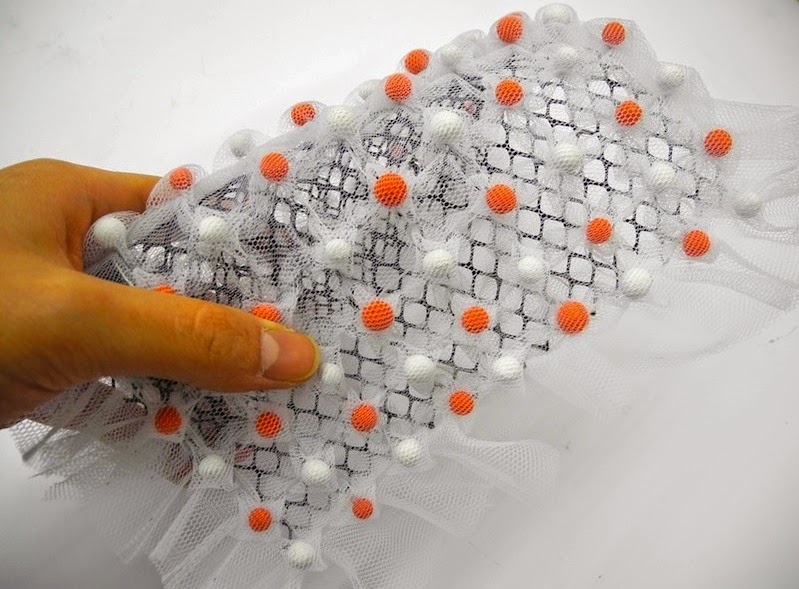
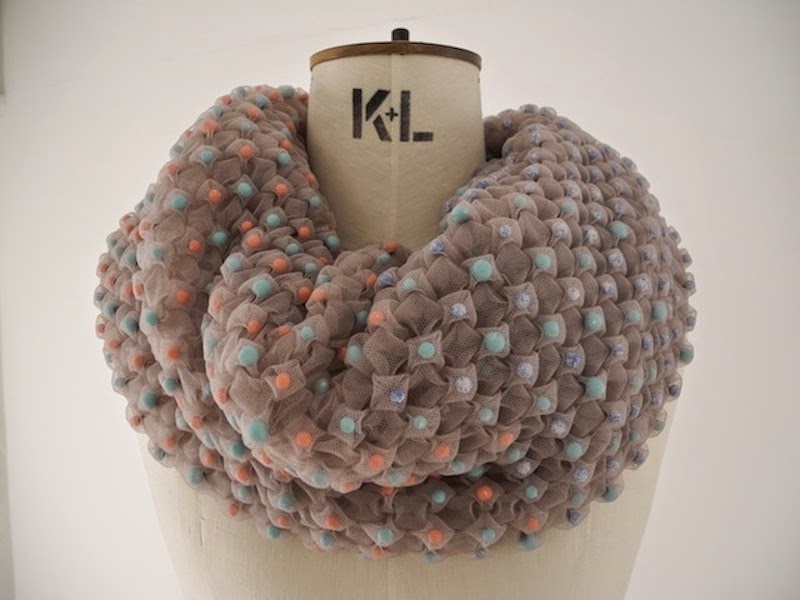
I have been away from this idea because of the drawbacks I mentioned above, but decided to try again and overcome the problems with the new idea. The second challenge went better. Smocking with see-through fabric allowed me to express colour, and it is still at the slight level but I started seeing the connection between my sample and what I am looking forward to. 

Including the smocking idea,  my textile design is becoming more abstract in comparison with drawings that I got from term1.  However, I haven't been able to abandon the graphic patterns completely neither, and being irresolute. A decision has to be made, and it won't be far after, so what I need to do is more visualisation, until I get the certain direction towards my final collection.


Left: Hand rolled stuffing balls     Right: Smocking sample with see-through fabric

 Left: Visualisation     Right: Smocking sample inspired and colour-matched by one of my drawing

23 February 2015

development samples

Having looked at visualisation, and I started sampling this week.
Compared to the technical exploration over the last few weeks, the second phase of sampling is more straightforward as I simply mix and match the techniques and designs. The two different aspects (technical and visual) of my project are finally married this time, and I am happy with it.

For the first development sample, I chose from my drawings instead of from developed designs. This is because I aimed to develop my samples in the same way that I developed my designs, also because I still doubt if it is necessary to transform the original drawing into 'textile patterns' that we usually see.

Unlike the technical samples, the new samples were produced in a systematic way in order to translate the drawing into embroidery as precisely as possible. Accordingly machine work was needed, and it was new to this project, new to myself too. I have been interested in laser cutting since I knew about it, and I have been curious about the collaboration of hand embroidery and innovation. The attempt turned out successful, although I do need to collect right materials for the final.

Left: Adobe illustrator drawing for laser cutting  Right: Stitching a part of the sample   

Left: Original drawing  Right: Stitched sample (approx.15x24cm, painted card board, straws, beads, snaps)

                  
Left: Photoshoped visualisation of the drawing  Right: Sample on a mannequin

In later this week, I created another sample in the same style but with the different material so that I can familiarise myself with varied materials that are potential for future sampling.
The plan for the next week is the development sampling of abstract patterns, that will be followed by sampling of repeat patterns.

Left: Cork sheet being vinyl cut  Right: painted and stitched sample (approx. 9x15cm)

16 February 2015

visualisation

Visualisation is a challenging task for me at all time. As an embroiderer, I am often dominated by embroidery ideas throughout the project and used to make less effort at visualisation. To avoid this, I had to obtain another perspective as well as textiles, and in this project it is fashion.

digital collage—scaffolding and a man
Above is a digital collage which I combined my primary research photograph and a male model. Recently I recognised my technical samples are comparable to scaffolds at building sites, and this is an attempt to link the technical and contextual aspect of my project.

Below, there are 3 sets of photoshop visualisation.  The first is experimental collages. It focused on silhouettes rather than patterns but I am happy with it because I used to apply patterns into ready-made clothes and felt less personal about it. The second, patterns exploration, was not a plan at first, but some of repeat patterns turned in positive way as they looked fairly different to the original blocks. The bold, one-off pattern worked well but it didn't exceed my expectation, and overall I felt those patterns might be 'too safe' to achieve the aim of the project. The last is the combination of repeat patterns and abstract accessories that I drew inspiration from medical casting and splinting. It is the most potential visualisation as it included the elements of both drawings and technical samples.

silhouette exploration

patterns exploration

cast-inspired accessories


In next week I am going to continue visualisation, and hopefully start sampling some of those.


7 February 2015

self-directed study—am I directing myself to the right way?

This week was one of difficult weeks in my design process.
I urged myself to 'produce' and neglected to 'think', and it prevented the progress of this project as a result.

The week started with continuing work of the technical exploration that was a only successful part in this week. The focus of the exploration was changed from the stitch itself to the overall appearance, so that I can imagine those embroidery samples as products. As you can see in a couple of samples below, forms of samples started being natural that fit to the body, and it let me look into fashion context rather than interior.


Although the samples are successful from the technical point of view, it was doubtful if they were relevant as a part of my project. I started wondering if my technical exploration is slightly going wrong direction, as I have recently relied upon my personal 'taste' specially for material selection. It must be okay to explore around the core idea but what I have been doing seemed to be out of theme, out of control. Accordingly I decided to visualise my design process (below) and it helped me to understand the current situation.


During my tutorial, it is emphasised to look at all my drawings in order that I can identify what is successful and what is not through the reflection. The target of a coule of weeks ahead is to bring the components together and get the right direction towards the final design.

7 January 2015

Annual DP(design process) time has come! — take a look back and plan next

Term1 started slow but passed quickly.
The theme of my final project is building sites and construction. I selected this theme because of three reasons. Firstly, I was attracted by boldness and heaviness of materials. Secondly, I liked brightness and strong contrasts of painted colours. And the third is, how the first and the second are opposed to general impressions of embroidery.

Embroidery has a very long history in many regions around the world, and the fine pieces by skilled craftsmen (and often housewives) are seen in museums and art books. This type of traditional embroidery seems to be independent from contemporary embroidery techniques, and thus traditional hand embroidery is less popular within contemporary embroiderers while machine embroidery is becoming popular in textile industry.  It was natural for me to challenge the combination of two —traditional and new— so that I can demonstrate the traditional stitches are still great techniques as means of creating new textiles in this contemporary world. With my intention to reconstruct the general impression towards embroidery, I am going to have three key words—bold, masculine and modern.

As a starting point, I selected and combined multiple research photos. The result was satisfactory but I needed to translate the photo collages into coloured paper version, in order to analyse colours and shapes. Paper collages helped myself to consider about compositions and colour combinations, but a lot of details and texture have been dismissed in the process of simplification.

To focus on texture and details, I had an idea of getting inspiration from completely different themes. Melted candies and candles have been set as the second theme, however, it did not work together with the original theme and I abandoned this idea at the end.

Although the previous attempt drifted myself from the mainstream, I was able to try out many different materials. Also, this experiment added 3D qualities to my work, and accordingly the second half of term1 was spent mainly on 3D exploration. Firstly, I am interested in clay. The clay objects were good enough in terms of texture, but forms and sharpness were far less satisfactory; therefore I had to find another way of expression. Second challenge was painting on wood board, however, again it was not successful because of mixed dull colours and rectangle templates. Finally I found foam boards as the best material to work with.


Unlike clay, farm boards are still flat without manipulation, and I had an idea to solve this problem—layering. Layering is very simple but effective way of giving 3D quality to drawing, and I liked it. Artists such as Frank Stella is looked as Secondary research. First challenge of farm board 3D objects are still small, less texture and even colours are not as fresh as my 2D paper collage. Therefore I decided to double the size, and made texture and colour samples beforehand. Not all samples are successful but I am still happy with some of details on texture samples, and applied them to bigger layered objects.

 
My first consideration about my textile design was textile design for menswear, however, after 3 months of exploration I started thinking that my designs do not necessarily need to be fit into garment shapes. In this new term, I am going to find out the best way of presenting my textiles, as well as developing my designs as embroidery.